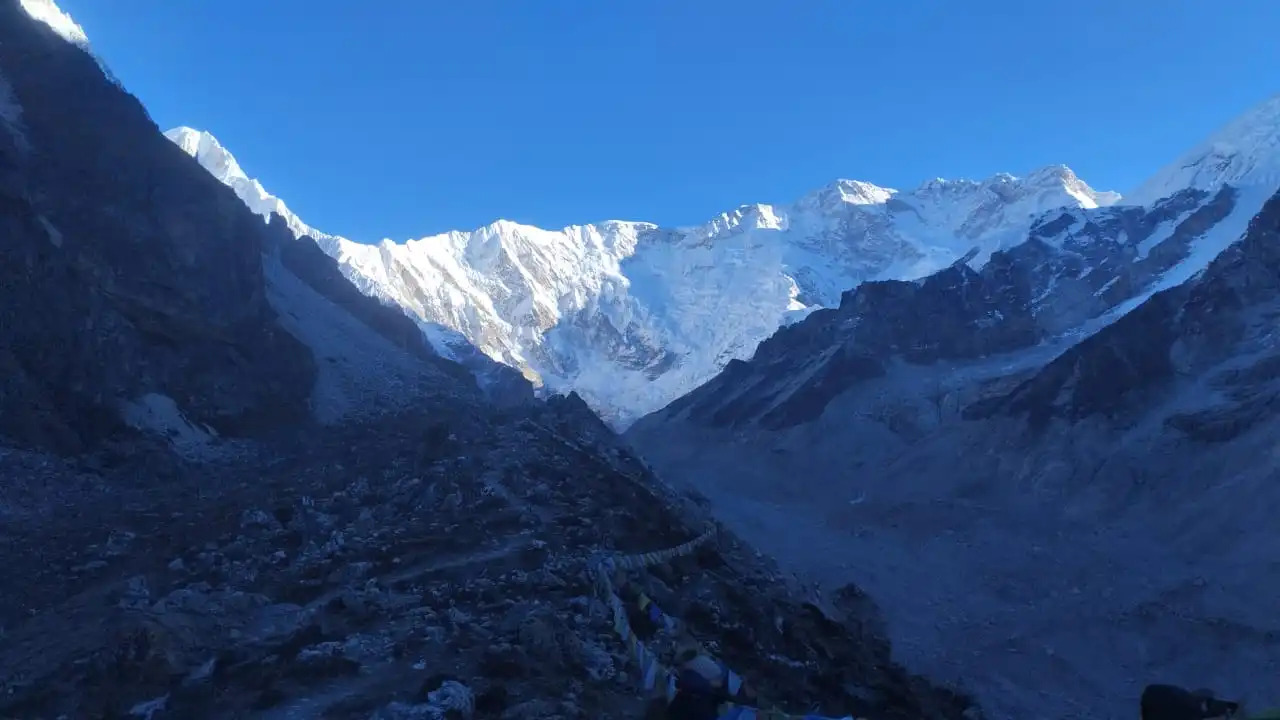
Sele La Pass
This is the high-altitude link between the Northern and Southern sections of the trek. It actually consists of a series of passes (including Mirgin La Pass and Sinelapcha La Pass).
It is the most weather-dependent part of the trek; if there is heavy snow, the crossing can become impassable without technical gear.
Flora, Fauna, and Red Panda
The Kanchenjunga conservation area is a biodiversity hotspot. You will walk through everything from tropical jungles to the Alps to the Tundra.
It is one of the few places in Nepal where you might spot the elusive Red Panda in the bamboo bushes near Gyabla and Ghunsa. You may also see Blue Sheep, Himalayan Griffons, and various other species of Rhododendron.
Glacier and Glacial Lakes
The trek is defined by the massive Kanchenjunga Glacier in the north and the Yalung Glacier in the south. You will spend the days walking along their lateral moraines.
While there are several small glacial lakes along the high passes, the sheer scale of the moving ice rivers is the primary geological attraction.
Ilam Tea Garden
Ilam, often referred to as the “Tea capital of India,” is a beautiful region that feels no less than a piece of heaven on earth.
The hills look finely carpeted in neatly trimmed tea bushes that produce world-class orthodox tea. It provides a beautiful, serene start and end to the trek, contrasting with the rugged, grey, and white world of high mountains.
Biratnagar
One of the major points during travel is the city of Biratnagar, located closer to India and sharing a border; it is a significant point that is often used as an alternative for traveling back and forth during the trip by flight, in case of flight cancellations due to various reasons.
Since it is a metropolitan city, the provision of transportation of any sort, be it flight or road, is available from morning first hour to late hours in the evening, giving you smooth access for transportation and traveling.
Why is Kanchanjanga a restricted region?
To maintain the area’s pristine state and protect its unique Heritage, the Kanchenjunga Circuit is officially classified as a restricted destination by the Nepal government.
The designation is primarily driven by three core factors they are national security, environmental conservation, and preservation of local indigenous cultures.
Geopolitical sensitivity
Strategically positioned at the crossroads of Nepal, (Tibet) China, and (Sikkim) India, Kanchenjunga is a sensitive frontier zone. Because the trails run in a closed proximity to these International borders, the region is under strict government surveillance, and monitoring foot traffic in these outskirts is essential for maintaining border security and regional stability.
Ecological Preservation
As a vital part of the Kanchenjunga Conservation Area, this region serves as a sanctuary for endangered species, most notably the Snow Leopard and the Red Panda. By restricting access, the government can manage human impact on these fragile habitats.
This “low-impact” approach ensures that biodiversity remains undisturbed by the footprints of mass tourism.
Cultural Integrity
The area is the ancestral home of the Limbu Rai ethnic groups. Keeping the region restricted allows these communities to maintain their traditional way of life and spiritual practices without being overwhelmed by the Rapid globalisation and commercialisation. It ensures that the cultural experience for the visitors remains authentic rather than performative.
The Kanchanjanga region serves as a vibrant living archive of ancestral customs, folklore, and Himalayan intelligence. Trekking through this corner of eastern Nepal introduces with diverse tapestry of ethnic communities, including the Lepchas, Sherpas, Tamangs, Rais, and Limbus.
Each group maintains its own unique dialogue, traditional attire, sacred festivals, and distinct social cultures.
Daily life and Livelihood
Most inhabitants of this region lead modest labour-intensive lives deeply connected to the land. As you pass through the valleys, you will observe local herding yaks and dzos, tilling terraced mountainsides and sun-drying maize.
All the trekking industry is gradually expanding, the community’s foundation remains rooted in traditional farming, livestock rearing, and ancient spiritual values.
A Spiritual Melting Pot
Tibetan influence is a defining feature of the upper Kanchanjanga trail, evidenced by the colourful prayer flags, stone mani walls, chortens, and historic sites like Ghunsa Gompa. The region’s spiritual identity is uniquely complex; orthodox Buddhism lives side by side and Shamanism and animist beliefs.
Common for locals to see guidance from a Shaman or a prayer to the mountainous spirits and legendary deities.
Mythology and oral traditions
In these remote villages, the spoken word is considered sacred. While resting by a fire, you may hear elders sharing chilling legends of Dzo-nga, or the Kanchenjunga demon, a Yeti-like figure believed to inhabit the high peaks.
Others might tell of a hidden mystical Valley of eternal life tucked over in the mountains’ crevices, a secret Paradise protected by spirits and known only to the Limbu and Lepcha people.
Guide and Porter for Kanchenjunga Circuit Trek
The Kanchenjunga Circuit Trek is a part of the restricted region, since it’s a restricted region for overseas travelers, trekkers are not allowed to go on their own. Instead, they are legally required to go in a group of at least 2 trekkers.
If someone is on their solo trip and wants to go for the Kanchenjunga Circuit Trek, then they can manage through a travel agency, which will issue permits for 2 trekkers, which includes the guide (mandatory for overseas travelers) and the trekker themselves.
Certified Guide, Porter, or Guide cum Porter
Since the overseas travellers are prohibited from traveling alone due to safety reasons, the government of Nepal has mandated that to travel in groups of at least two with the following provisions:
As for the Guide and Porter, you have options like:
Professional Guide, a well-trained and well-experienced on-field tourism professional who will give you the best and well-coordinated guidance under their supervision and make your trip the best possible. The charge for the professional certified guide is USD $40-45 per day.
Porter, it is recommended for people, especially when going on a restricted region trek like the Kanchenjunga Circuit Trek, to mandatorily have a porter, to ease with load, as the region is comparatively rugged than other regions and might exert more strain on the body. The standard porter charge is USD $25-30 per day.
Guide cum Porter seems more expensive compared to the Guide and Porter individually, but it is much more budget-friendly and logical for people on a budget, especially for the youth with decent fitness and cardio endurance, travelers who can carry some of their own luggage, sharing half with the guide.
Since the Guide cum Porter is doing the role of two professionals, the cost when individually compared might seem higher, but is lower when calculated collectively. The charge is $35 USD per day for this kind of professional guidance facility.
Regulatory requirements
To prevent the chaos of unregulated tourism and keep the landscape as raw as possible, the government enforces specific entry rules:
No solo trekking: You are strictly prohibited from trekking alone; you must be accompanied by a licensed guide.
Mandatory permits: Trekkers must obtain a special restricted area permit, which is generally more expensive and harder to acquire than the standard trekking cards, TIMS.
Group size: usually a minimum of two trekkers is required to process those specialised documents
Is it possible to trek only the Kanchenjunga North and South Base Camp without doing the entire circuit?
Yes, certainly you are not required to commit to the full Kanchenjunga Circuit Trek to enjoy the beauty of the secluded Himalayan treasure. If you are captivated by a high-alpine environment and wish to stand at the foot of the world’s third-highest peak’s massive ice walls, the Kanchenjunga North base camp trek (Pangpema) is the ideal choice.
Conversely, if you prefer a shorter timeline focused on a rich cultural experience and vibrant landscape, the Kanchanjanga South base camp trek is recommended. This route leads you to charming villages and terraced farms, offering a personal encounter with local people.e
Both the north and South routes function as independent, deeply satisfying Journeys. Each provides a quiet experience of an “off-the-beaten-path experience in Eastern Nepal, complete with the stunning peaks, peaceful solitude, and a warm teahouse hospitality.
These Itineraries are fully adaptable, whether you have a strict schedule or want to add extra days for rest and photography. Info Nepal Treks can design a plan that caters to specific needs.
With more than 10 years of experience navigating these wild sections of the Kanchenjunga Himalaya, we have an intimate understanding of the local weather and sacred viewpoints that typical guides overlook.
Our team of licensed professionals and highly safety protocols guarantee that your trip, whether to the north or the South or both, will truly be a memorable
Kanchenjunga treks solo vs Group joining for 2026/2027
To be clear, embarking on a completely unassisted solo trek in the Kanchenjunga region is prohibited. Its status as a restricted zone, the Government of Nepal strictly mandates that a minimum of two trekkers must be accompanied by a licensed guide who must be registered with the authorised trekking agency.
The Private Trekking Alternative
However, you can certainly organise a private Kanchenjunga Base Camp trek consisting of just yourself, a guide, and the Porter. This option offers you complete autonomy to move at your own speed, take breaks whenever necessary, and a customised path to your liking.
This is a perfect choice for those seeking deep solitude, high-altitude photography, or a tranquil mountain experience away from the commotion of large groups.
Understanding the ghost permit workaround
Standard regulations usually require a second person in the group to secure a permit, but a ghost permit of a solution that your trekking agency can facilitate by including a second (Inactive) name on the official documentation, meaning you will cover the permit fees for two individuals. While this increases the cost, it grants the freedom to crack solo with only your professional guide.
Group joining for better value.
Alternatively, if you wish to reduce expenses and satisfy the legal permit requirements, you can join a pre-arranged group trek. This is a much more economical approach as you will share the overhead for transportation guides and photos with other travellers.
Expert logistics and support
Unsurprisingly, a solo-style Kanchenjunga trek is much more expensive because you are personally financing all your logistics. With Info Nepal Treks, you can choose between a bespoke solo-style adventure or a group expedition for the 2026/27 season.
We handle every detail, including a restricted area permit, professional guiding, strategic pacing, and comprehensive safety protocols. Having guided on these trails for over 10 years, our local team possesses intimate knowledge of every bend, nook, and corner, as well as twists and teahouses and trail conditions.
Trekking Preparation Tips For the Kanchenjunga Circuit
For an Insured and successful, and safe insurance expedition, you have to follow these professional guidelines drawn from over a decade of experience in the Eastern Himalayas, recommended by professional and experienced trekking veterans.
Physical conditioning for a minimum of 4 weeks
The Kanchenjunga circuit is a physically demanding feature in relentless ascents and consecutive days of high-intensity walking.
It is vital to begin an endurance training program at least a month before your departure. Focus on your cardiovascular health, leg strength, and stair-climbing exercise to ensure your body is conditioned for steep topography before you arrive in Nepal.
Physical Conditioning (Minimum 4 Weeks)
The Kanchenjunga Circuit is physically demanding, featuring relentless ascents and consecutive days of high-intensity walking. It is vital to begin an endurance training program at least a month before your departure. Focus on cardiovascular health, leg strength, and stair-climbing exercises to ensure your body is conditioned for the steep topography before you arrive in Nepal.
Prioritise Acclimatization
With the exceeding elevation above 5,000 m, at Pangpema and the intermediate passes, your body faces significant physiological stress. Since altitude sickness can manifest as low as 3,000m, you must never ignore or least symptoms falling a professionally designed Itinerary with built-in rest days is not negotiable for allowing your assistant to a depth set to the thinning air.
Versatile Packing Strategy
The weather and the trail are not really unpredictable for a cycling Through The Four Seasons in a single 24-hour period, you must be prepared for everything from intense mid-day heat to freezing Alpine Nights.
Essential gear includes a high-quality four-season sleeping bag moisture moisture-wicking layers or a waterproof outer shell, thermal underwears, and sturdy, well-broken-in trekking boots.
Regulatory Compliance and Permits
Because Kanchenjunga is a protected and politically sensitive border on, you must secure your Restricted Area Permit and a Kanchenjunga Conservation Project (KCAP) permit.
The law and its that you trek with at least one other person and a licensed guide through an authorised trekking agency. Independent solo trekking is strictly prohibited in this region.
Selection of a professional agency
The success of your trek depends on your support team. It is crucial to book through a government-authorized local agency like Info Nepal Tours & Treks, as the team comprises indigenous mountain professionals who possess intimate first-hand knowledge of the specific area and its unique challenges.
Mental fortitude for remote living
Prepare yourself for a complete digital detox, as the region has no convenience for Wi-Fi and no immediate medical facilities in the wilderness. It is completely raw nature echoing and surrounding you from all four directions, giving you a sense of solitude and back-to-nature primate feeling of living and survival in a way as you cut off every modern touch of comforts and communication with just raw visuals of the untamed side of the Himalayas, as if nature is staring through your soul.
Optimal seasonal timing
Choosing the right time to do is critical for safety, and planning your trek during the Spring (March to May), Blooming roadway entrance for Autumn (September to November, for the clearest sky outside of this, Windows heavy is more monsoon rains can make these high passes extremely dangerous or impassable.
Nutrition and intense hydration
Fill your body with calorie-dense local meals like Dal Bhat, which provides sustained energy. To prevent digestive issues, it is wise to avoid meat products in remote high altitudes. The aim is to drink three to four liters of water daily, as proper hydration is the primary defence against acute mountain sickness (AMS).
Comprehensive emergency insurance (helicopter evacuation)
Given that you will be several days away from the nearest Road, cheaping out on insurance is a massive risk. Ensure your policy specifically covers trekking up to 6,000 m and has a provision for emergency in the event of an injury or severe illness.
An aerial rescue is often the only way out of the Kanchenjunga region, as the failure of uneven or, even if available, are not suitable for road transportation, specifically in such an emergency health situation.
Transportation and Road conditions to the Kanchanjunga circuit trek
Getting to the Kanchanjunga circuit, the trailhead is an adventure on its own, with roads, long routes, long drives, and some serious bumps guaranteed.
You can fly to Bhadrapur, then take a jeep to Taplejung, or go old school with a full-day public bus if you are on a budget.
You can also take a private Jeep all the Way. All in all, your choice totally depends on your time frame, budget, and trekking style.
Nepal visa & currency
Something not to put in the shade while considering the trip to the wilderness of the Kanchenjunga region, trekking is getting your essential pre-trek preparation details.
Like sorting out your Nepali rupees, obtaining your entry visa, and withdrawing enough physical cash are essential tips that could literally determine the success of your journey.
Currency exchange and ATMs
It’s better and recommended that you exchange currency in Kathmandu, as there are plenty of ATM in Thamel and the trail has none.
Also carry enough cash in smaller denominations as they are more useful and easier to transact in teahouses. You can obtain any number of notes of usable denominations from banks, forex, or even local store vendors.
Before you head into the isolated backcountry of the Kanchenjunga region, ensure you do not overlook these vital preparation details.
We will break down these requirements for you now to ensure you are not caught in a crisis later, stuck at 3,000 metres with a stamped passport but no access to usable money.
Visa process
For the majority of nationals, often the provision of an on-arrival visa can be issued at the Tribhuwan International Airport, which is the most convenient option to use the digital visa kiosks. After completing a brief form and submitting your payment, you’ll be all set to begin your trip. This process is generally efficient and straightforward, offering a stay duration of 15, 30, or 90 days to match the length of your expedition.
For those who prefer to organize their travel documents in advance, you may also secure a visa through a Nepalese consulate or embassy in your home country. Regardless of which method you choose, it is vital to ensure that your passport remains valid for at least 6 months beyond your entry date.
When it comes to covering the visa costs at the airport, having the physical currency is the most reliable strategy. While card payments are technically accepted at the terminal, the machines can sometimes be temperamental; consequently, the cash-only line often moves significantly faster when electronic systems experience delays.
Visa exceptions for Kanchenjunga Circuit Trek
Even though many countries and their citizens are eligible to get a visa on arrival in Nepal, there are some exceptions depending on the nature or status of the traveler. The Government of Nepal has added a few countries and the nature and status of certain types of travelers to the list as follows:
Also, if you are a foreign resident or a citizen with pending status, have a traveler’s passport, or if you are a refugee from any nation or a citizen from any of the following nations, then you are not eligible for the on-arrival visa, so in its alternative, whatever the obligation is, the company will do the needful upon your cooperation.
- Nigeria
- Ghana
- Zimbabwe
- Swaziland
- Cameroon
- Somalia
- Liberia
- Ethiopia
- Iraq
- Palestine
- Afghanistan
- Syria
-
Hotel in ktm/ lodge & Teahouses on route
-
Kathmandu
-
Kathmandu
-
English proficient guide and other language options available
-
Breakfast, lunch and Dinner
-
Flight/Jeep/Bus
-
Mandatory helicopter evacuation needed/ guide & porter only covered
-
Efficient & smooth in city. Slower, might have pay extra on higher elevation with rising elevation
-
English, Spanish and Germans aviavlable (other on-request available)
-
5-6 hours daily
-
All form of card payments and online in Ktm, only cash on trail
-
10
-
75
Trip overview of the Kanchenjunga Circuit Trek
The Kanchenjunga Circuit Trek stands at the ultimate frontier of those seeking the raw on filter essence of the Himalayas are calling the its massive footprint of the mountains and 8,586m, the world’s third-highest peak. This journey is a masterpiece of geographical and cultural diversity. Unlike the crowded corridors of Everest and Annapurna, Kanchenjunga remains a restricted sanctuary preserved for adventurers who value solitude and the authentic rhythm of Mountain life.
The expedition is a grand traverse to the Kanchenjunga Conservation Area, taking you from the subtropical tea Gardens of Ilam to the high Alpine desert of the Tibetan border. It is a rare double-sided trip that connects both North and South base camps, linked by the formidable Sele Le La high pass. Through the remote villages where Sherpa, Limbu, and Rai cultures have remained unchanged for centuries.
Choosing this circuit means choosing the path less traveled. It is a demanding 22-day odyssey that requires physical and mental fortitude, but it rewards you with the landscape of peaks and silence that is increasingly hard to find, whether you are chasing the glimpse of an elusive Red Panda or the golden glow of a Himalayan sunset on a sheer Ice wall. The Kanchenjunga Circuit is not just a trek; it is a true mountain expedition into the heart of eastern wilderness.
Highlights of the Kanchenjunga Circuit Trek
- Dual Base Camp access
- The “Throne of Gods” Mt.Jannu (Kumbhakarna)
- High-Altitude Pass Crossings
- Lhosar
- Tibetan New Year