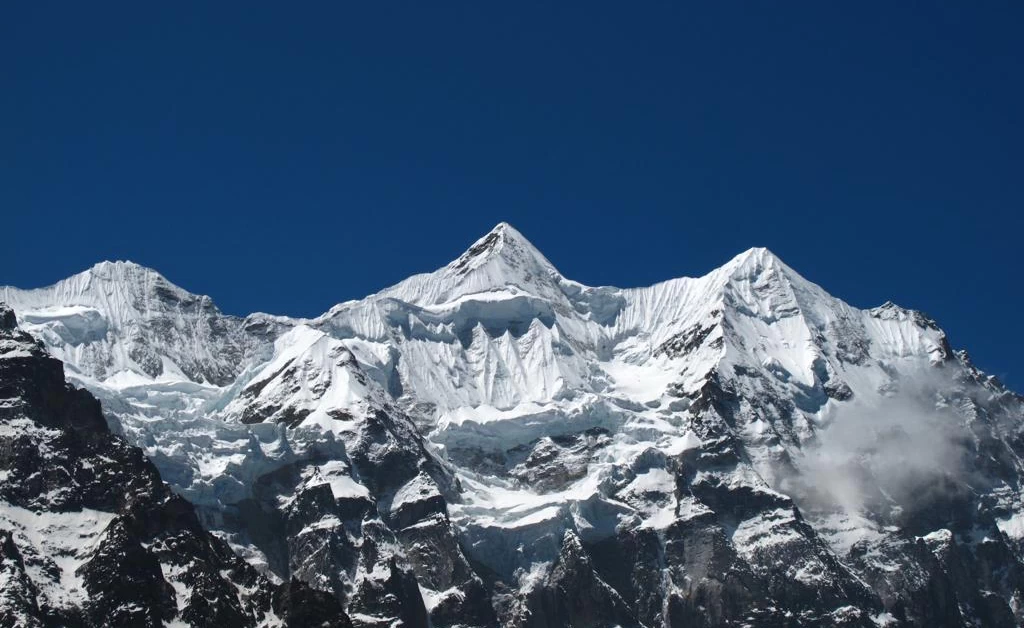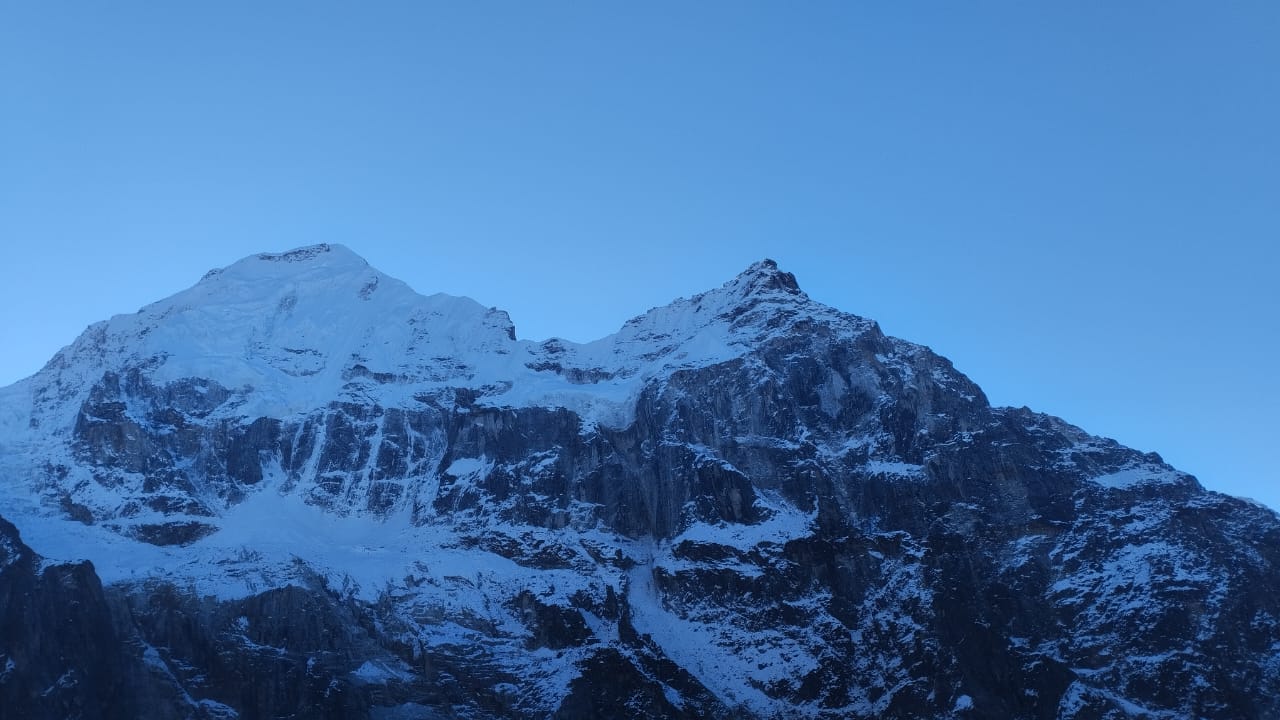
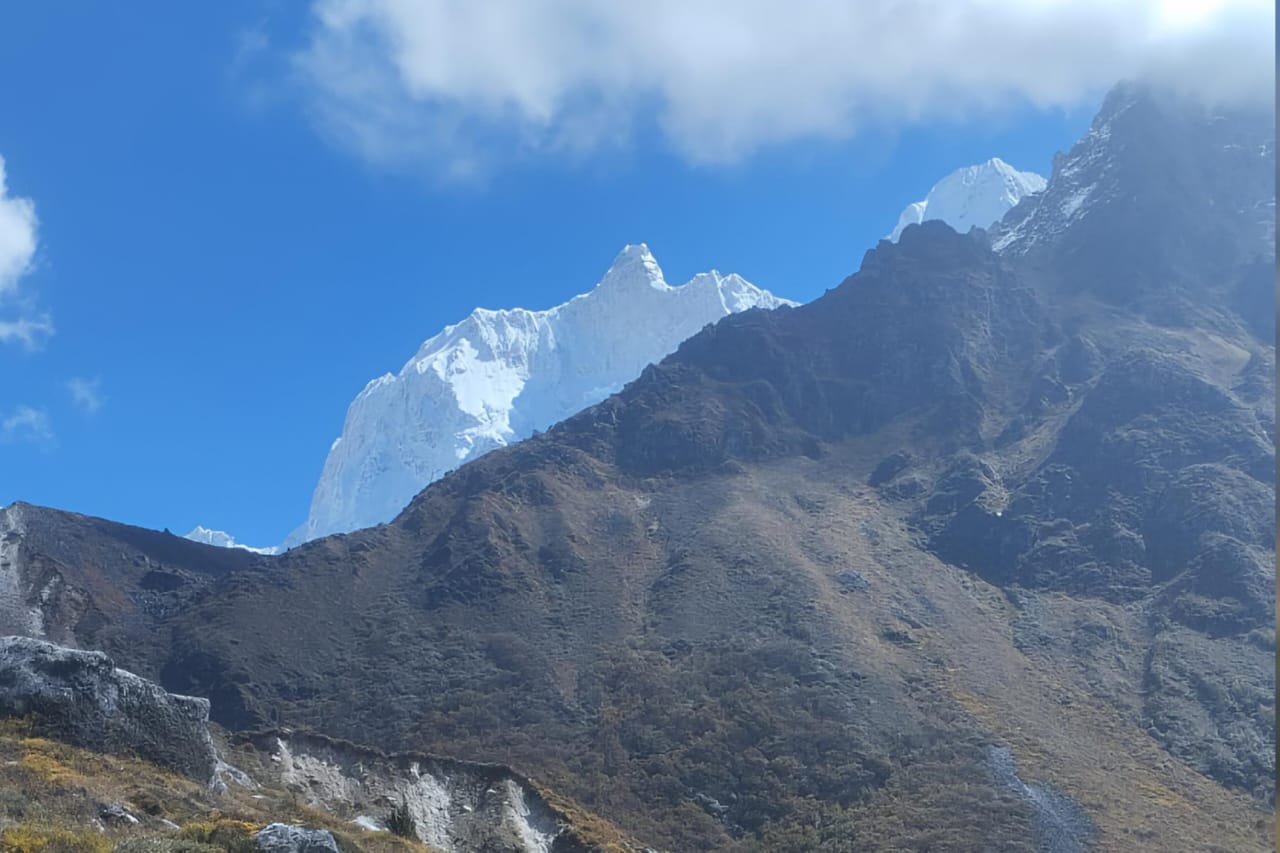
The Kanchenjunga trek in April, considered one of the “Five Treasures of the great snow,” stands at 8,586m. Trekking here in April is a journey into one of the last truly wild corners of the Himalayas. Unlike the crowded Everest region, Kanchenjunga offers a sense of solitude and a raw connection to nature.
This isolation ensures that the ancient traditions of the Limbu and Sherpa communities remain untouched by heavy commercialization, allowing for deeply authentic cultural exchanges. As you navigate the high-altitude glacial moraines, the silence is broken only by the distant thunder of ice or the whistle of the Himalayan wind.
The sheer scale of the landscape, from the sub-tropical valleys to the towering North face, creates a profound sense of humility and wonder.
Every step on this rugged terrain feels like a tribute to the pioneers of mountaineering, offering a rare opportunity to witness the mountains in their most primal and majestic state. It is not just a hike, but a spiritual pilgrimage into the very heart of the world’s third-highest peak.
The Kanchenjunga trek in April experience: springs in the wilderness
Considered as the heart of the pre-monsoon season, while the rest of Nepal begins to warm up, the high elevation trails of eastern Nepal are just waking up from their winter slumber.
The vibrant burst of rhododendron
The Kanchenjunga region is home to over 30 species of rhododendrons. In April, the trail from Suketham to Amjilosa becomes a tunnel of red, pink, and white blossoms.
The “clear window.”
April provides a specific meteorological window where the dust of the planes hasn’t yet risen to the haze of the mountains, and the monsoon clouds are still weeks away. You get high-definition views of Kanchenjunga North Face that are simply not possible in other months.
Cultural awakening during the Kanchenjunga trek in April
You will pass through Hamlets of the communities like Rai and Limbu in the lowlands and Tibetan Buddhist Sherpa villages (like Ghunsa) in the highlands. In April, villagers are active in their fields preparing for the growing season, offering a more authentic look at the mountain life than the “tourist-only” villages found elsewhere.
Weather & Climate: A detailed breakdown
The month of April is also synonymous with high temperature gradient, as you start in the sub-tropical lowlands (Taplejung) and end at the edge of the glaciers.
Upon breaking down the elevation in segments, you’ll find the differences in the temperature of daytime, nighttime time and the weather conditions.
For instance, the Lowland, Taplejung, and Mitlung reach temperatures of 20°C to 28°C during daytime and are usually humid, lush, and warm, whereas the nighttime temperature drops to around 12°C-15°C.
So as the elevation rises, the temperature drops further. Furthermore, as the steps approach mid-hills around Ghunsa, Gyabla. The temperature in here during the daytime is 10°C to 18°C and drops down to 2°C to -5°C. Even if it is cold at night, the weather during the day is perfect for walking.
Approaching higher on the steps, the elevation rises, and the temperature drops further down as even the daytime temperature barely stays stable around the range of 0°C to 7°C during the daytime, and as the nights approach, the temperature drops further down to -10°C. To -20°C, as even if in the day might be kind of sunny, the night and evening are kind of windy and freezing.
Note: In April, Anabatic winds are common. Expect calm mornings with strong upward blowing winds in the valleys after 2:00 PM.
Logistics, permits, and the two-person rule for the Kanchenjunga trek in April
The ecology and region of Kanchenjunga borders both India and China, which is why it is strictly regulated to protect its border sensitivity with the requirement to follow certain rules as mentioned below:
- Mandatory guide: You are not allowed to trek Kanchenjunga sol, which is why you must hire a licensed guide through a registered trekking agency.
- The “Ghost” partner: The law requires a minimum of two trekkers for a permit. If you are a solo traveller, agencies can often find a paper partner for you, but you must still have a guide.
- Permit costs:
- Restricted area permit (RAP): USD 20 per week (first four weeks).
- KCAP Entry fee: NPR 2000 (USD 15).
- Connectivity: Do not expect the Wi-Fi in April. Some lodges in Ganza may have satellite Internet, but it is expensive and unreliable. A satellite phone or Garmin inReach is highly recommended.
Detailed 22-day circuit itinerary Kanchenjunga trek in April
Phase 1: The tropical approach.
Day 1-4: Fly from Kathmandu to Bhadrapur, drive to Taplejung, and begin the trek through the humid Tamur River Valley. You will see cardamom plantations, which are considered the “black gold” of this region.
Phase 2: Entering the high valleys
Day 5 to 8: The trail narrows. You will climb through the steep stone steps to Amjilosa and Ghyabla. The air cools, and the vegetation shifts from bamboo to pine and larch.
Day 9 to 10: Acclimatisation in Ghunsa (3,457m): This is a beautiful Tibetan village with wooden houses and prayer flags. Use this day to hike toward the Dudh Kunda (Milk Lake)
Phase 3: The North Basecamp
Day 11-13: Trek to Lhonak, a high-altitude pasture. From here, you do a day hike to Pangpema (5,413m), the north basecamp. You are now standing directly beneath the massive north face of Kanchenjunga.
Phase 4: crossing highpass
Day 14-16: This is the hardest part, you’ll cross the Sele La (4,290m) and Sinion La (4,440m) passes. In April, these passes often have knee-down snow, requiring gaiters and steady footing.
Phase 5: The South Side and Descent
Days 17-22: Visit Oktang (4,730m) for views of the south face and Yalung Glacier. Then, begin a long, knee-jarring descent through the forests of the Simbuwa Khola back to civilization.
Kanchenjunga trek in April, Responsible trekking & ethics
Since it is a fragile environment, tourists need to know how to behave.
- Leave no trace: Emphasize the importance of carrying out trash and using water purification instead of buying plastic bottles.
- Supporting Local Economy: Encourage trekkers to buy local handicrafts in the villages to directly support the remote communities.
Cultural tapestry: Beyond the mountains
Traversing across the topography of Kanchenjunga is not just an expedition and adventure but also a different level of experience in itself. As your steps approach further from the ethnic lowlands towards the high-altitude glacier, you’ll pass through a “vertical map” of different ethnic homelands, each with its own language, culture, architecture, and spiritual traditions.
The Limbu Heritage of the lowlands
The early stages of the trip will take you through the heartland of the Limbu people. Unlike the famous share price, the limbo have a distinct culture centred around Kirat, an ancient indigenous religion that predates Buddhism. You will see traditional wooden houses perched on steep hillsides and may be offered Tongba, a traditional drink made of fermented Millet served in a wooden canister with a bamboo straw.
The high-altitude Sherpa and Bhotia villages
As you ascend above 3000 metres to villages like Ghunsa and Phale, the cultural shifts towards Tibetan Buddhism. Here, the landscapes are adorned with colourful prayer flags, Mani walls (stone carvings), and ancient monasteries (Gumbas). The people here, often referred to as Bhotias, have lived in the High Valley for centuries, trading salt and wool across the Himalayan passes.
The Legend of the Yeti
Kanchenjunga is famously known as the Yeti’s playground. Local folklore is rich with stories of the Mogoi (a wild man of the snows). Many elders in this region still believe this creature inhabits high, uninhabited caves near the glaciers. Adding a stop at local monasteries often reveals old paintings or artefacts that locals believe prove the existence of this mythical being.
Authentic hospitality
Because this region sees a fraction of the tourists that Everest does, the interactions here are genuinely warm. In April, you might find yourself invited into a family’s kitchen to sit by the fire and experience that offers a rare, unvarnished look at their resilience and kindness of the Himalayan people.
Teahouse vs camping: Managing expectations.
Kanchenjunga is more rustic than Everest. When planning a trip to Kanchenjunga, it’s Vital to understand that tourism infrastructure is years behind the luxury standards of the Everest or Annapurna regions. This is a journey for those who prefer authenticity over comfort.
Basic amenities
Unlike the purpose-built hotels in Namche Bazaar, the “Tea Houses” in Kanchenjunga are often just the humble homes of local families who have opened their doors to the travellers. You will likely sleep in simple wooden rooms with twin beds and thin mattresses. Common areas are centred around the single wood-burning stove, the only source of heat in the building, where travellers and locals huddled together to stay warm after sunset.
The food
While you will find basic pasta or pancake options, the primary fuel for this trip is Dal bhat(lentil soup, rice, a nd vegetable curry). It is the only meal that offers the 24-hour power needed for 8 hours of trekking days.
However, the Kanchenjunga region offers unique flavours of the locals. Keep an eye out for Gundruk (tangy fermented leafy greens) and Sukuti (spice-dried meat), which provide a salty, nutritious kick to this standard mountain diet.
No luxury (the digital and physical detox)
You must prepare fir to the lack of modern conveniences or showers. Flush toilets and stable Wi-Fi disappear almost immediately after leaving the lowlands. Charging your camera or phone often involves a fee and a solar panel that may not work in cloudy April afternoons. There are no luxury lodges here; instead, your luxury is profound silence, the mountains and sky full of stars undisturbed by light pollution.
Kanchenjunga trek in April, Physical training & acclimatisation.
Such a long trip requires more than just a weekend warrior fitness. You will need to have a strong cardio and endurance training regimen recommended with the twelve-week training programme involving stair climbing with a weighted pack in order to build physical endurance, especially for the back and shoulders.
Along with that, you’ll need to have mental resilience and determination, cause no matter how much of a Hulk you are think you are a warrior, if you are someone especially a lowlander the mother nature will humble you in places like Nepal as you’ll be passing across the nature’s architecture that reflects solitude and loud silence on trip of 6-8 hours daily on average.
And the most important rule for anyone and everyone planning to travel is to climb high and sleep low, as this technique helps your body to collaborate in acclimatization with the elevation you have risen.
Conclusion
Trekking Kanchenjunga in April is not just a casual holiday, but also a rigorous test of endurance and a rare privilege. You will trade the comforts of modern life for freezing nights and dusty trails, but in exchange, you will receive a view of the world that very few will ever witness.
In the shadow of the “Five treasures of the Great Snow,” the noise of the world fades away, replaced by the blooming rhododendrons and the vast, silent glaciers. If you are seeking a trail where the mountain still feels wild, and the culture remains pure, Kanchenjunga is calling. ,